

Is your life better than you think?


Happy Friday, Intentionalists!
One of the things I love about being a novelist is the sense of collaboration I have with my readers. I only have words to convey characters, locations and feelings. I am like a hypnotist guiding my subject with suggestions. The rest of the picture is made up by my readers, who bring their own thoughts, emotions, experiences and imagination to the story.
As a result, there are as many versions of my stories as there are readers for them. This is why readers often feel cheated when their favourite books are made into movies or TV series. The filmmaker may present a very different story from the one they had imagined in their head.
‘Reality’ is often taken to be static, solid and universal. But the truth is, reality is in the eyes of the beholder, and there are as many different versions of it as there are people on the planet.
Our reality is made of how we perceive the events in our lives, which means that what we believe and how we think has a large part to play in the outcomes we experience.
Luckily for us, our brains are capable of ‘meta-cognition’ – the ability to observe our thoughts and choose to consciously think different ones. Unfortunately, most of us never learn how to harness this genius power.
Some live under the illusion that if they think a thought, it must be true. And that the feelings they experience are a direct response to the circumstances of their lives. For example, their boss reprimands them and they feel discouraged; or they have an argument with their spouse and feel angry the rest of the day.
Because we aren’t taught how to ‘think well’ as children, nearly all of us suffer from one type of ‘cognitive distortion’ or another. As a result, many of us spend our days going up and down emotionally like kids on a seesaw and feeling like victims.
An example of a cognitive distortion is black and white thinking. For instance, the belief that people are either entirely good or entirely bad, not nuanced or merely faulted. Or that if a project hasn’t entirely succeeded, then it is a total failure.
I’ve witnessed this kind of thinking and its outcomes firsthand. I once knew a woman who wrote a magnificent debut novel. It was very well received by critics and readers, but it didn’t achieve the bestselling status that the publisher and author had anticipated. The author branded herself a ‘complete failure’ and gave up writing. To this day, she tells me she can’t even go into a bookstore without crying over ‘what might have been.’
At the other end of the spectrum, I know another writer whose first book didn’t gain her a large advance or much publicity. She had average sales and the reviews for her work described her book as ‘a pleasant beach read,’ but not in any way outstanding. But because she wasn’t prone to ‘black and white’ thinking, this writer was able to recognise her partial success. She had managed to finish a novel while caring for young children (major achievement), she’d found a publisher for it (even bigger achievement), and she’d managed to please enough readers with her first published book that she’d been given a contract for a second one. (Yowza!)
Building on this success, she learned how to improve her writing from reader feedback, and she studied how to market her next book better. Five years later, she’s now a major bestselling author who doesn’t cry when she walks into a bookstore.
While it’s easy to see the blind spots in other people, we aren’t so good at recognising our own cognitive distortions. Yet, they can also change the outcomes we experience in our lives in major ways.
Today, we’re going to take three common cognitive distortions and get you to contemplate whether you are under the influence of them.
So, grab your journal and a pen, and let’s get started!
THREE COMMON COGNITIVE DISTORTIONS
1. MIND-READING
This is where we believe we know what another person is thinking. For example, we may think that they believe we’re lazy because we don’t work out every day like they do. Or we may imagine they’re as in love with us as we are with them, which can be a sign of limerence on our part.
The truth is, it’s impossible to know exactly what another person is thinking, and assuming what they are thinking can lead us into chaotic situations.
The best way to ascertain what someone is really thinking is to ask them. But this needs to be done with a note of caution. We can’t ask them what they are thinking in a manipulative way, trying to get them to admit to what we suspect or want to hear, eg. You are angry at me, aren’t you? Come on, spit it out!
It’s much better to encourage them to speak authentically. To do that, you need to ask in an open-ended manner eg, You seemed to me to be a bit distracted at dinner. I’m wondering if something is on your mind? Would you like to share it with me?
You also need to create an environment where it is safe for them to speak their truth, and not make them feel pressured by fear of judgement by you (or the threat of a huge emotional meltdown).
Making it safe for people to express their honest thoughts and feelings to you, and to ask them what they are thinking rather than assuming that you already know, is a sign of maturity and self-assurance. The more you practice doing this, the calmer and more self-assured you will feel. It is much better to accept that someone sees you as a friend, rather than spend months planning your wedding to them in your head.
Think of a situation you’re currently experiencing where you might be mind-reading another person? Can you create a safe space for them to express themselves authentically to you? Are you afraid of what they might answer if you ask them? How might your life be better if you truly knew where you stood with this person? How might it improve the relationship?
2. INCORRECT COMPARISONS
This is when we compare ourselves to someone who we perceive to be more attractive, successful or clever – and as a result, judge our own lives to be worthless and ourselves to be losers.
This is an extremely common cognitive distortion.
Have you experienced it recently? Who did you compare yourself to, and where did you feel you felt short in comparison to them?
This person may have some terrific things going for them, but that doesn’t mean that you have absolutely none. Think of the two writers I mentioned in the introduction. If the second writer had compared herself to the first when they were both starting out, she might have felt like a loser herself. But luckily, she was clear enough in her thinking to know that she had things going for her too and to capitalise on them.
What are some of the blessings you have in your life? What are some of the things you’ve achieved? What are your best strengths and qualities?
It’s important to keep reminding yourself of your blessings and good qualities. It’s the best way to avoid this type of cognitive distortion.
3. EMOTIONAL REASONING
This is where you judge yourself or a circumstance entirely based on how you feel. This means if you are experiencing a negative emotion, such as disappointment, then you decide that your entire life must really suck.
An example of this might be someone who is going through a painful break-up. Heartache hurts, there is no doubt about it. It brings with it painful feelings of loss and rejection. But it also captures all our focus. We think only about our broken heart, and forget that we also have family and friends who love us, a loyal animal companion, a nice apartment, an interesting course of study, good health, etc
The best way to handle this is to acknowledge what is hurting and upsetting us and to accept that, for the time being, this part of our life has not turned out as we’d hoped. But at the same time, it’s important to give ourselves something to look forward to each day so that the pain doesn’t consume every part of our lives and distort our thinking.
Other examples of emotional reasoning include feeling nervous about giving a speech or taking an exam and believing that this is evidence that things will not turn out well. Or ‘imposter syndrome’, where a fully qualified person doesn’t feel confident about their ability to perform a role simply because everything feels new.
Check in with how you are feeling about your life right now. Is emotional reasoning causing you pain in any way? How can you refute it?
We titled this newsletter ‘Is your life better than you think?’ a little ironically. Because our lives can never be better than the quality of our thoughts. That’s why it’s so important to challenge our cognitive distortions.
If you’d like to improve your thinking and live your best life, grab a copy of THE FEEL GOOD NOW JOURNAL. It’s a conditioning program to improve your thoughts in just a few minutes a day.
Check it out here: feelgoodnowjournal.com


⚘ Spread the good vibes ⚘
If you enjoyed today’s newsletter, we’d love it if you could give us a heart.
If you think a friend could do with its uplifting message, feel free to use the button below to share it with them. Let’s make life good together 💌
FEEL GOOD AFFIRMATIONS
I guide the direction of my thoughts. I hold onto only those that are constructive
I improve the quality of my thinking each day and take joy in the peace that results
I observe my thoughts carefully. I choose my own reactions to life, and that empowers me
(Pick an affirmation and say or write it slowly ten times. And if you want to repeat all the affirmations, that’s wonderful too!)
✧ If you’d like more tips to be intentional and feel great every day, be sure to follow us on Instagram and Facebook ✧

KELLY’S SILLY BIT
Hey, killer diller fam. I hope this week's been on the beam for you and you haven't snapped your cap. I had FAR too much fun the other week with 40s slang. If you missed it (and have no idea what I’m saying), you can catch up in the newsletter below↓:

1940s slang Part 2
Anchor Clanker
Meaning: a sailor
My nan used to tell me that the sailors would say ‘Hello tits, I mean toots!’ Unimpressed, she’d tell them where to go. Those Yankie anchor clankers didn’t know what to do with the barrage of salty language that came at them from that magnificent woman.
Knuckle Sandwich (or Knuckle Butty for our UK mates)
Meaning: punching someone in the mouth or stomach
The origin lies somewhere in the gangster movies of the 30s and the American sports field. Adopted by both the UK and Australia. In Australia, it was featured in the play Norm and Ahmed by the Australian playwright Alexander Buzo. Please enjoy this exquisite scene:
I remember one bloke. A real coot. Played prop for Balmain juniors. Tall bloke, he was. A long thin streak of pelican shit. He tried to hang one on me at Leichhardt Oval once, so I administered a knuckle sandwich to him.
Copescetic
Meaning: Excellent or very satisfactory
Its origins are still being debated, but one thing that isn’t is that it’s SO FUN TO SAY! CO-PAH-SET-IC!
Floy floy
Meaning:
Nonsense
I have been on a JOURNEY with this word. What I originally thought just meant nonsense … has a WHOLE other meaning. There’s a 1938 jazz song called Flat Foot Floogie (with a Floy Floy).
Have a listen, it’s pretty catching, I mean catchy:
Michael Jackson recorded a version. And it was used as inspiration for the title of The Three Stooges film Flat Foot Stooges.
Ready? Floy floy was slang for a venereal disease (most likely syphilis). And Floogie was just a word they made up instead of saying floozie (so they didn’t upset their record label), but they needn’t have worried! It wasn’t a widely known term, so it was regarded as a nonsense term and came to have a positive connotation BECAUSE of this song.
They use the phrase flat feet as apparently some chronic venereal diseases ultimately lead to flat feet. So sing that one more time!
Humdinger
Meaning: a remarkable, extraordinary or outstanding person or thing.
Its etymology is of US origin. They think it may be a blend of two words:
hummer - something that moves fast
dinger - something outstanding
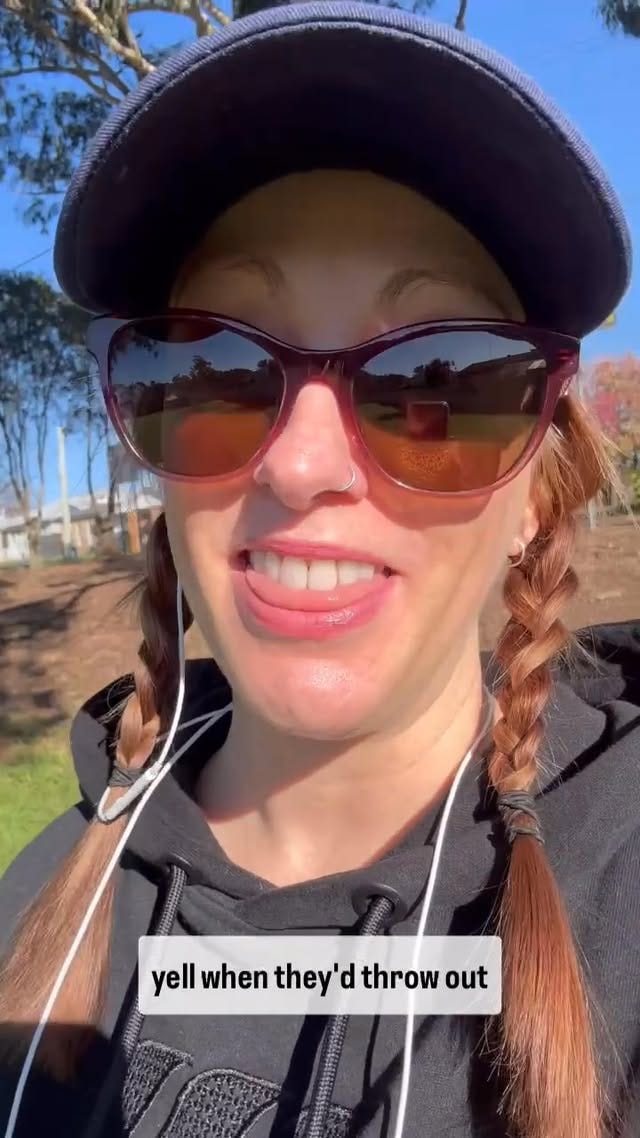
I should be back out with my boy for new silly word videos next week. Please enjoy an oldie and a goodie.
P.S. If you haven’t yet, treat yourself to a copy of The Feel Good Now Journal, because feeling great isn’t just for Fridays!
Be an intentionalist.
Belinda & Kelly XX
PS: Please tap the heart button on this post if you enjoyed it, or share it with a friend! It helps people discover it on Substack. Let us know what you think in the comments!
✧ Read our previous newsletters ✧